
Under my window, a clean rasping sound
when the spade sinks into gravelly ground:
My father digging…
The trouble with most landscape art is that it is about looking at the landscape, not being in it. It is no coincidence that Britain, where I come from, became the first country where more people lived in towns than the countryside1 and has famously had an especial obsession with landscape art. From painting to travel posters, most landscape images function as nostalgic or escapist views for city dwellers in London, Singapore, Manila, wherever. Our desire for such images is a symptom of an extreme estrangement from the countryside—from soil, plants, animals.2
How to make art that conveyed more of a sense of being in the land and in nature rather than just looking at images of it? Land art of the 60s through the 80s sought ways of closer engagement: walking (Richard Long), building (Michael Heizer), farming (Agnes Denes), and engaging with animals (Joseph Beuys).
Half a century of urbanisation on, the world is increasingly seen through the ubiquitous computer screen and in a state of climate emergency—the need for art that engages with land, nature and earth has become even greater.
In this essay I want to look at how one artist, Geraldine Javier (born 1970 and based in the Philippines), has sought to do that—and share that engagement with her audience.
Earth. In art when we talk about the word earth we are probably yet again deflected into thinking of the word landscape and landscape paintings or photographs. However, it is important to note that landscape is a word that only began to be used in the late 1590s. Shakespeare never uses the word landscape; instead, as Ian Mortimer points out, “he uses the word country—a concept in which people and physical things are intimately bound together.3 Tellingly, Hamlet uses “country matters” as a euphemism for sexual intercourse.4 Earth in the famous graveyard scene is synonymous with death and decay.5
This cycle of sex, birth and death in the earth is emphasised brutally in Emile Zola’s 1886 realist novel La Terre (Earth). He recounts to us how Fouan, a 70-year-old farmer, “had once been very sturdy, but now he was dried up and shrunken, for he had worked so hard, his passion for the land had been so fierce that his body was now bent as though ready to return to the earth he had coveted and possessed so violently.”6
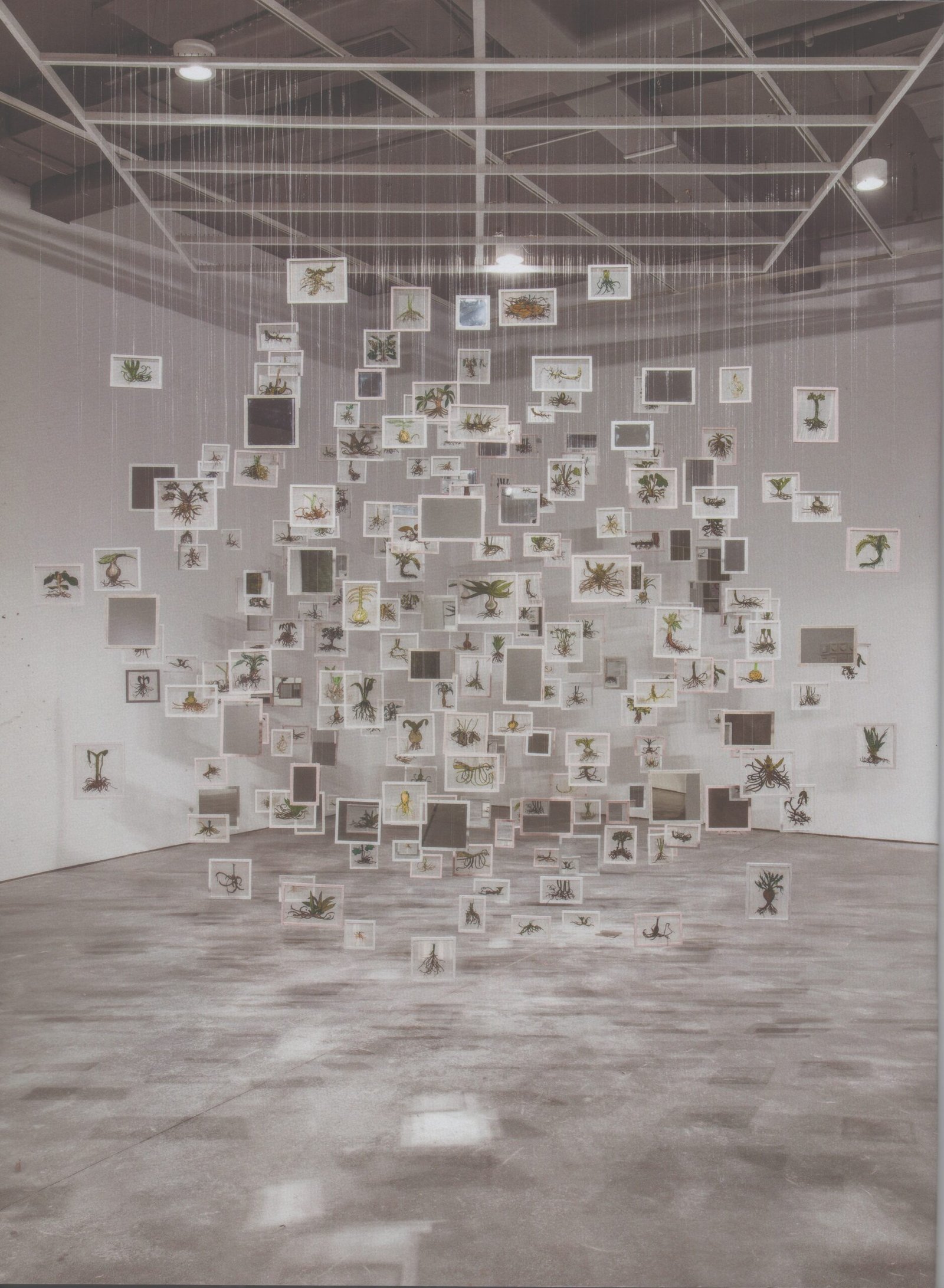
Geraldine Javier. Oblivious to Oblivion, 2017.
189 panels of embroidery, 54 small mirrors, dimensions variable.
As another aged farmer, Hourdequin, walks across a field to see his ploughmen, Zola tells us: “the soil clung to his feet, he could feel its rich fertility as though the earth wanted to hold him fast in an embrace, and the earth possessed him again completely; he recovered the virility of when he was thirty, his strength and happiness. Earth was the only woman: there were no other.”7
Farming is hard work, back-breaking at times—long hours, the vagaries of weather, poor pay— but, as John Berger wrote, a way of life that offered an important corrective to working in a capitalist city, one more connected to the physical world and to life.8 Landscape painting rarely shows the slog of farming, peasants almost invariably being portrayed as happy and decorative—see the work of J.M.W. Turner, Cheong Soo Pieng or Fernando Amorsolo.9 Like Zola, a few 19th-century realist painters like Millet, Courbet and Van Gogh, depicted farming, especially digging, as hard labour. However, Landscape and Earth, like Art and Nature, are generally more often seen to be opposites.
Art and Nature, Earth and Landscape have a very interesting meeting place or interface—the garden.10 Over the last thirteen years the garden has become site, subject and paradigm for the work of Geraldine Javier.
After a childhood in the provincial town of Candelaria, Javier moved to Manila to study nursing, then fine art at the University of the Philippines. In the house she lived in, in Sampaloc, a congested area of Manila, she had a mere handkerchief of a garden, plus two balconies filled with potted plants. She had always been nostalgic for certain parts of her life in the provinces. Since the age of eight, she had helped her father in his garden and accompanied him on trips to the rice fields that he managed. Unlike her seven siblings from the start, she was fascinated by plants. But she did not see nature through the rose-tinted spectacles of nostalgia; in 2012 I asked her, “Is your view of nature a benign one or a vicious one? Is it a caring ‘Mother Nature’ or Nature ‘red in tooth and claw’?”
“It is a combination of both,” she replied. “I feel at home in nature: I am not scared in dark woods or on high mountains. I like the unpredictability of nature: it can give you deluge or delight. This may be more acute in the Philippines where we have earthquakes, mudslides and typhoons—and also where we don’t care for our natural environment well.”11
She had grown weary of the noise, pollution and snarled traffic of Manila. “There is,” she said, “a strong desire to escape the city. Whenever I make works that have nature in it, they echo that desire, that longing to go back to a more idyllic setting… I spent my childhood and teenage years in the province and I know what it can do to you: there’s always a chance of complacency and a too simplistic view on life.”12 She was wary of what Marx and Engels called “the idiocy of rural life.”13 Nevertheless, the next year she bought an overgrown 2.3 hectare farm in the province of Batangas, south of Taal Lake and Mount Maculot.
“It was not just about a change of location,” she said, in retrospect. “It was about connecting with the environment. I’d been wanting to live and work where I could really connect with the things around me—and with the people around me. Whereas in Manila I was just holed up in my studio—I worked from pictures. I worked just with my head, basically. I found that oppressive.”14
She built a new house with a much bigger studio and began gardening on a far larger scale. Inevitably, her work evolved. However, even before this her work and philosophy had been changing.
Though Javier became well known for her paintings it is important to note that her first one-person exhibition (1996) was of collages. In classes by Roberto Chabet and others at the University of Philippines the emphasis had been on collage rather than drawing. She liked making things, she liked working with things from the real, material world—a key influence, one suggested by Chabet, was Robert Rauschenberg. From the beginning she was using thread in her collages. By the early 2000s she was making works with embroidery. By 2006 she was also using tatting, a form of crochet. She used a lot of dead natural things in her works: shells, antlers, animal bones, preserved bugs and butterflies—objects that fitted her recurrent theme of mortality.
When I first met her in 2011,15 she was painting in the day and embroidering in the evening; she was also employing four people to work as embroiderers or crochet-makers. She could sell every painting she made but rarely sold any fabric work. This was frustrating, but she insisted she would never make an exhibition just of paintings. There would always be textiles or mixed-media works and an installation—a term that, like most people in Southeast Asia, she uses loosely.
Crucially, in late 2011, in an exhibition at Singapore she exhibited two installations that made extensive use of hammered leaves,16 either hammered into fabric so as to print with its sap, or hammered on and preserved with acrylic emulsion. From that point on, plants—things grown from earth—were to become increasingly central to her work.
The year after buying her property, Typhoon Glenda17 passed through and left more than fifty trees uprooted. Javier had their roots sawn off, upended and sited like sculptures in her garden for plants to grow around or over. Gradually, through rot, lichen and termites became part of the flux, the constant decay and growth that any tropical garden is subject to. Hers was to be a garden that did not strive for some illusory perfection but one that always accepted that flux.
Like ‘landscape’ or ‘earth’, ‘garden’ is a word we use unthinkingly. Yet we have to ask, “what is a garden?”
The word is surprisingly difficult to define; there is such diversity; so many exceptions to every definition. In his book A Philosophy of Gardens David E. Cooper ends up defining it as the place where we do gardening. This may seem tautological but is not: a garden is defined by activity, both by humans and by nature, not by shape, size or function. Tellingly, the word ‘garden’ is both verb and noun. A garden is where we garden.
In recent years she has preferred to use the word ‘farm’, to be an artist farmer. How do we define her property and its purpose: garden or farm?
In truth her property has areas that can be seen as part garden (an emphasis on flowers, pleasant to walk around), part farm (where vegetables and fruit grow, including banana, coconut, mango, soursop, coffee etc.) but also part wilderness18—the north side of her property is the south side of a ravine, too steep to cultivate; on the other side of the ravine is the protected jungle/forest covering Mount Maculot. There is now a newly acquired area that should be termed an arboretum, a botanical collection of newly planted native trees. All these four areas can also be described as an extension of her studio. The door to her studio is always open: she wanders out periodically to gather flowers, bark or leaves, to see her dogs or just to unwind.
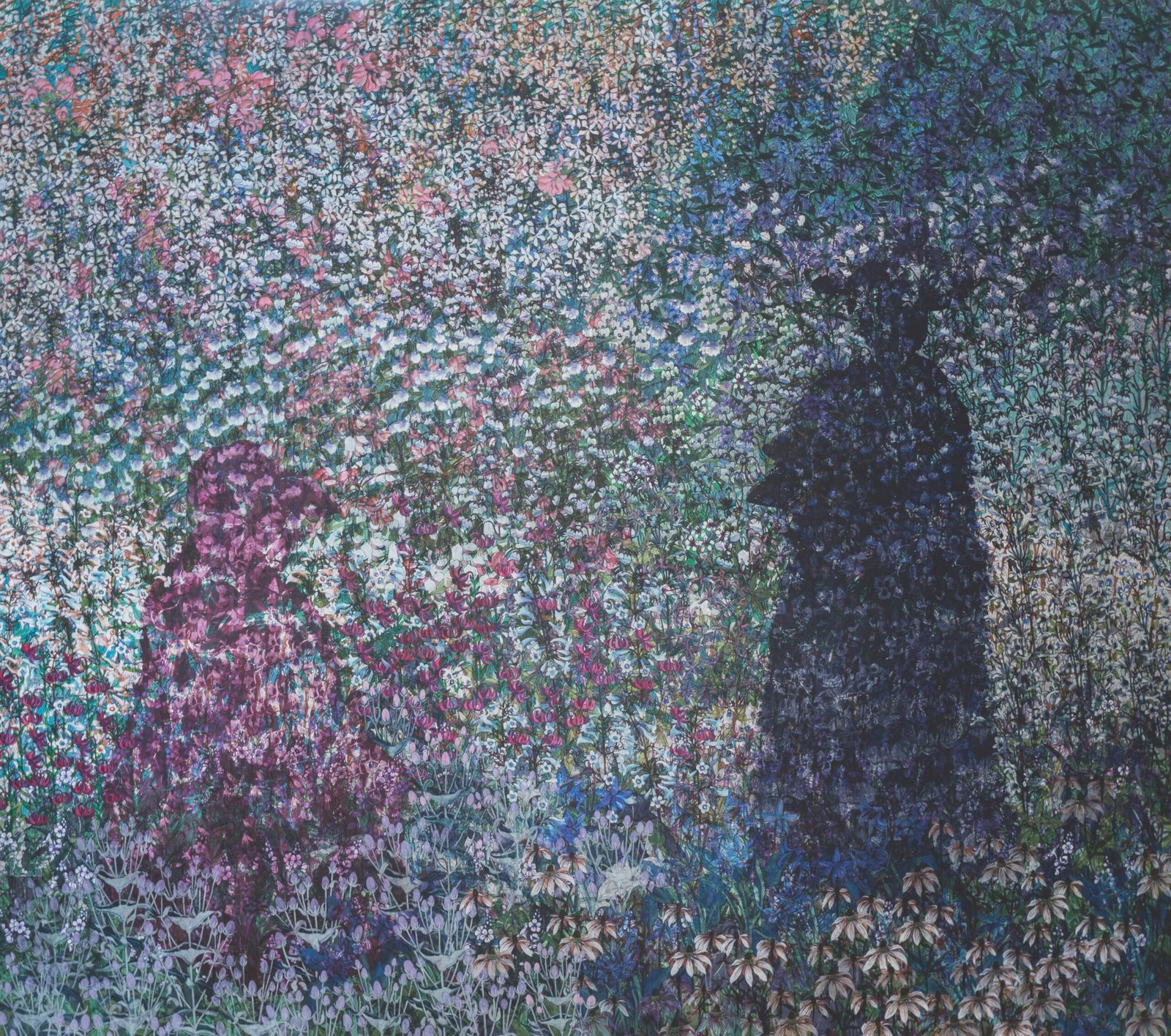
Geraldine Javier. Gertrude Jekyll (The Earth was her canvas I), 2020.
Acrylic on canvas, 213.4 x 243.8 cm.
For some time, she has thought of each show as an entity in itself, an immersive experience for the visitor, saying in 2013: “It’s not just a viewing experience where you put up works and people just go in and look at the individual works. I think my objective in every show is to prepare a feast.”19 It transpired that a better metaphor for her exhibitions was the hortus conclusus (enclosed garden). It is by following her exhibitions since then that we can see the evolution of her practice, a complicated progress towards an art of immersion and in-ness.
Her 2015 solo exhibition entitled Landscape as a State of Mind is a Landscape20 was her first show explicitly about her garden. There were images of her plants, her gardeners, her animals. She used hammered leaves, skeletonised leaves, embroidery, encaustic, deer and cow skulls, wood, charred tree stumps. In one area the viewer was surrounded by translucent fabric filled with insect eaten leaves.
In the exhibition wall-text she wrote: “It’s no simple pastoral dream. It’s hard work. Just as the birds and snakes from the forest slip into my garden and the noise of the barangay21 drifts over it, so memories and imaginings float into my consciousness. Life isn’t easier here, its complex in a different way… the trees and the nearby mountain are always there, a constant. And I find it easier to accept the irritations and vagaries of life. Now I am more at peace with myself, but not complacent.”
In that year, when asked what a garden meant to her, Javier replied: “being”—an unconscious echo of philosopher Martin Heidegger with his emphasis on being and things (sein and dingen). The words “presence” (Anwesenheit) and “belonging” (Ereignis or Mitsein) also appear in his writings. In his earlier writings a key word was nearness (Nähe) and in later writings dwelling (Wohnen). Belonging, nearness and dwelling are all close to what I have been calling in-ness.
Heidegger praises and defines Earth thus: “Earth is the serving bearer, blossoming and fruiting, spreading out in rock and water, rising up into plant and animal.”22 We need, to paraphrase him, to understand that the nature of our dwelling, of being at home in this earth, is to safeguard earth—not to master it but to care for it.
Although Heidegger is never an easy writer this cluster of words and thoughts is a good guide to the idea-complex underpinning Javier’s work.
Before studying as a fine artist, Javier had studied as a nurse for five years. Once when asked what she enjoyed most about a nurse’s work she said “stitching”. In medicine stitching is part of the healing process, closing wounds, making good again. Is it too outlandish to suggest that embroidery in her hands still carries associations with nursing—with taking care?
Two years later, one installation (Oblivious to Oblivion) had 189 panels of embroidery suspended along with 54 small mirrors. Each embroidery was of a small plant, roots and all. It was a hanging garden that one could walk into and in a mirror find oneself. Or one could see it as entering a potting shed with a myriad small plants waiting to be potted in earth or humus and watered. In another less successful installation—the mud would not dry—she, for the first and only time, used earth or mud as a base for a symbolic representation of the barangay (village or community) that she lives in, trees suggested by twigs and leaves, houses by miniature tents made with painted leaves on wood.
The inventiveness that characterises her installation work is equally to be found in the paintings of this period (she has always been stimulated by new materials or techniques). One painting shown at the same exhibition23 To the Gardeners of Kabul was inspired by stories of people in Kabul who carried on caring for gardens throughout the civil war despite the flying bullets. Here line drawings of plants are drawn with a brush one over one another until a complex network is built up, its effect surprisingly like Seurat’s pointillism. This palimpsest of botanical illustrations combined with the abstract and very material dripping of paint, hovers cloud-like between abstraction and representation. More than a botanical illustration it is a record of activity, of participation with flux.
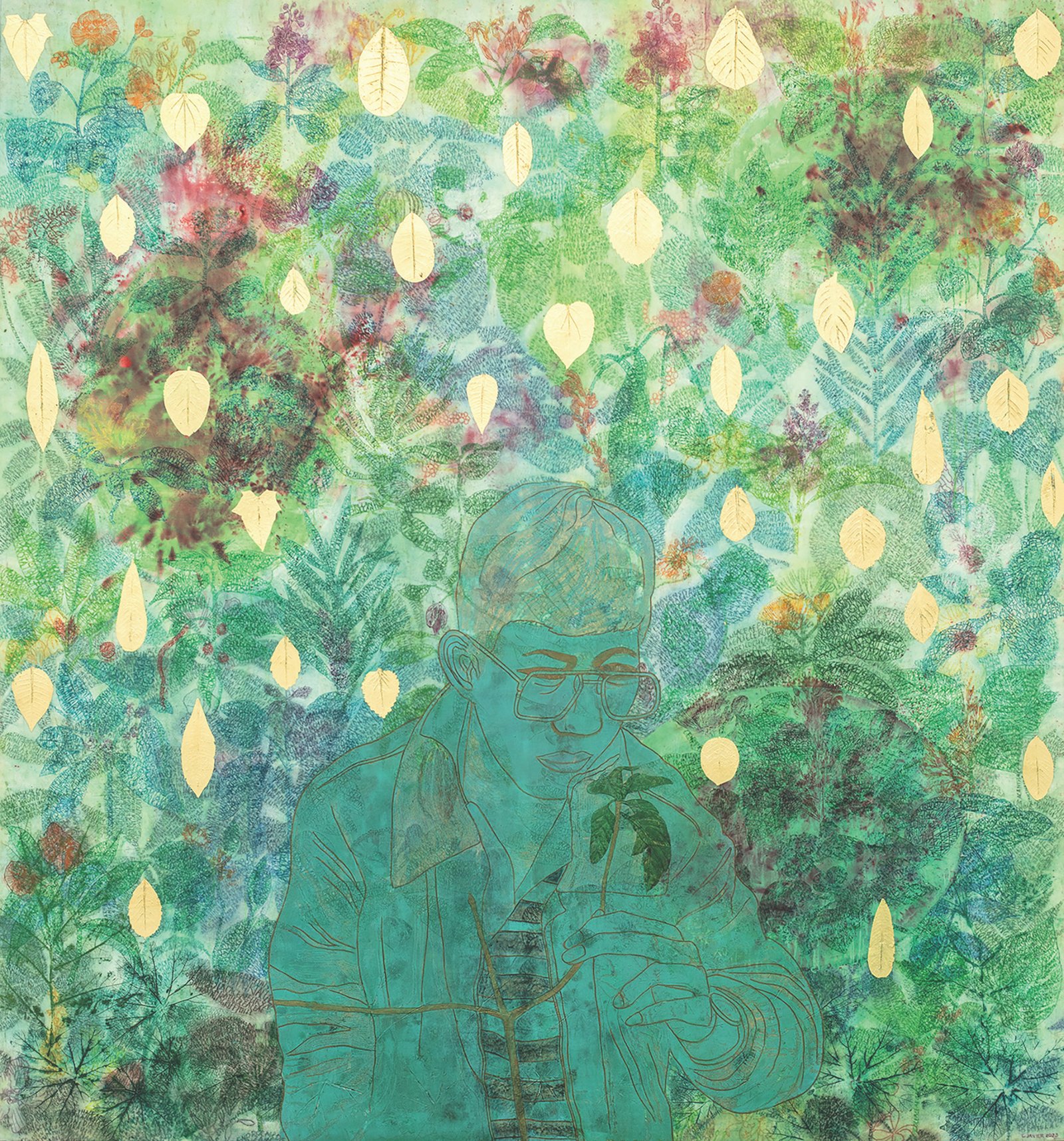
Geraldine Javier. Leonard Co, 2023.
Imitation gold leaf, ink pencils, encaustic on canvas, 204 x 198.5 cm.
Gardening, like farming, for her was not a private activity, but a communal one. For a garden this large, especially in the tropics where everything grows so quickly, and near to a volcano where the soil is so fertile, one pair of hands is not enough. In any one week as many as thirteen people may work on it, three more or less full time, but everyone is involved: her embroiderers often help out with weeding and watering, their children gather rubbish or sweep the paths.
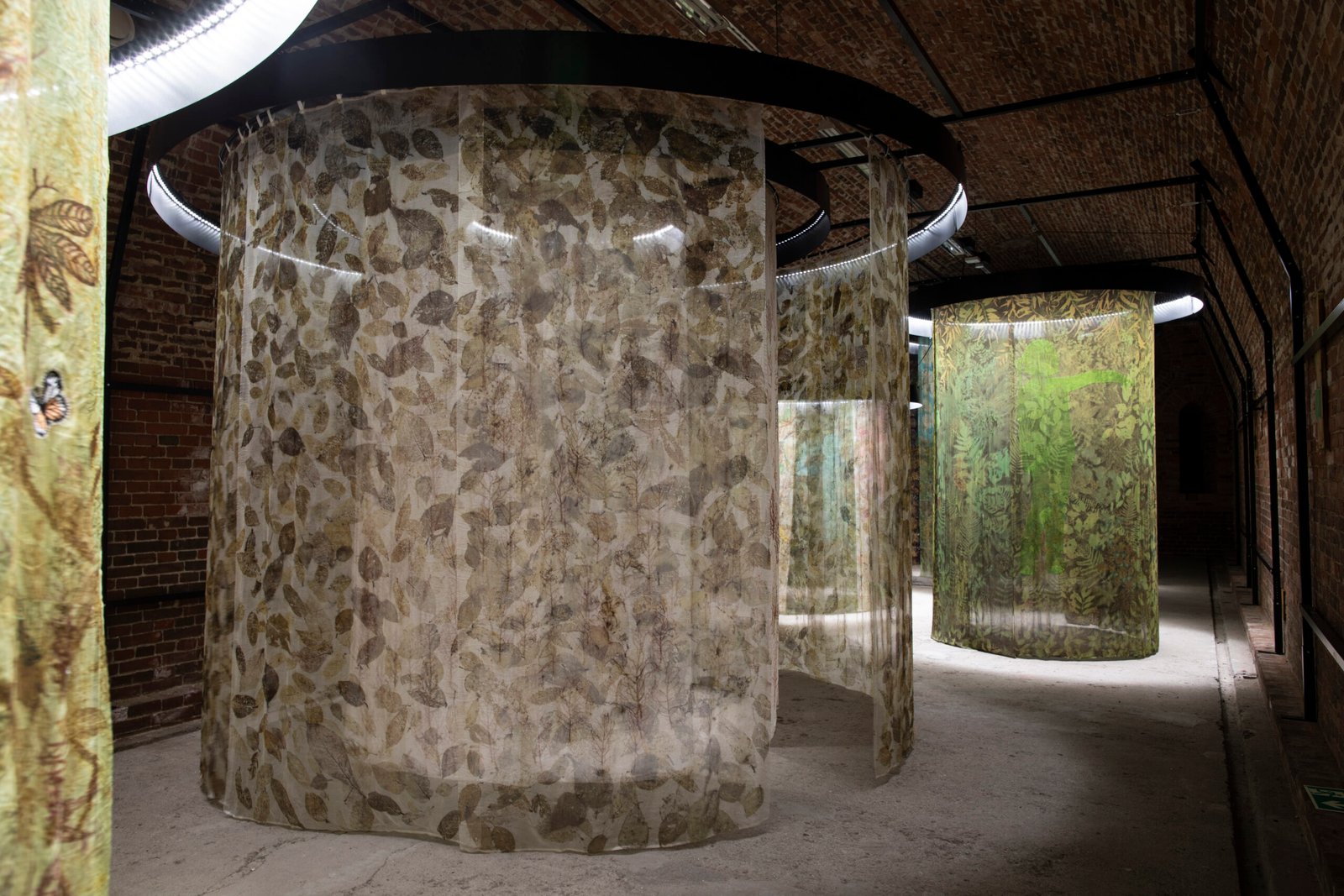
Geraldine Javier. Witness, 2025.
Five columns, hand embroidery, appliqué, natural dyeing, rusting and eco-printing on natural fabrics, 200-400 cm wide and 244-365 cm high.
During the pandemic she was concerned for those in her barangay who had lost their full-time jobs. Therefore she employed eleven of the jobless for the last six months of 2020 in an experimental organic farming project on some vacant lots. The eleven were paid a wage, grew a wide range of vegetables, learned how to garden organically, had fresh food for their families and even made some extra money by selling their produce. She did not see this as a social art work, just what any good citizen should do. Moreover, she learned a lot about organic farming.
Around this time she was especially moved by Robin Wall Kimmerer’s book *Braiding Sweetgrass.24 (She “read” it as an audiobook—like many artists she is great listener of audiobooks and podcasts.) Kimmerer, a native American, writes of indigenous knowledge and their reciprocal relationship with nature. “The best learning I got from her book,” Javier said, “is being able to give back and respect nature. It’s not just about taking. You give gratitude by protecting nature, by not taking so much and then being able to put back what you’ve taken. It’s always a reciprocity.” She is aware of the loss of equivalent indigenous knowledge in the Philippines. “We became disconnected, especially with the environment, when we got westernised, we forgot those traditions that actually sustained a community.”25
Although she was good friends with many Filipino artists and a member of the artist collective Surrounded by Water, she had no one who shared her passion for plants and plant-focused art.26 There was however a historic community of artist gardeners that she could summon in her 2021 exhibition27 of imagined gardens: Claude Monet, Derek Jarman, Gertrude Jekyll and Frida Kahlo. Kahlo and Jarman by installations, Jekyll by three palimpsestic paintings, in that reproduced here two images of Jekyll were submerged in a cloud or mist of flowers: the gardener literally immersed in the garden. The colour arrangements in the paintings (and whereas early paintings were highly figurative and graphic there is increasingly far more attention to colour) echo the plans for flower beds that Jekyll was famous for.
She had developed another painting method, used in the four Monet Garden paintings, that was more like mulching or composting: a layer of encaustic sediment having been set down on a canvas laid out on a table, she would draw on it with ink or scatter pigments on it, then she would get a blowtorch and melt parts of it, blending some of the pigments and drawing. Next, another layer of encaustic and again she would torch that, in parts blending it with the underlying layer. This process was repeated again a third and maybe fourth time. A complex surface (humus, compost) had been made. With the painting back on her easel, over several days or weeks she would carefully draw plants over it, referencing botanical illustrations. Eventually another layer of encaustic would be added and the blowtorch again melted or blended some of these plant images. It is all like the good gardener making a rich flowerbed with compost, dead plants, manure, and so on before planting for the new season. Finally, with the canvas back on the easel, she would sit down and again patiently draw plants.
Here paint is matter; also perhaps a metaphor for soil. The representations of plants are buried in the abstract mass of encaustic and paint.
For me this recalls the ideas and early work of French artist Jean Dubuffet (1901-1985). He emphasised the materiality of paint, what he termed matière or haut pâte, mixing it with mud, sand, ash or other stuff. This thick, once viscous mix of paint, soil and other stuff unified all the images that he carved into it. “Grinding up the materials and rediscovering the primordial touch of the child who kneads the sand and the earth, was what Dubuffet was interested in during [the 1940s].”28
It was an anti-elitist art. “I want an art that is directly connected to our everyday lives,”29 Dubuffet proclaimed. Javier however is not rebelling against the high culture and sophistication of Parisian art and culture as Dubuffet was, she does not need to take an aggressively primitive (Art Brut) stance.30 In her house there are many works of tribal or indigenous art (weaving, metal, wood) from Africa, Indonesia and the Philippines. She has great affection for these works; she is not however responding to them as embodying a primitivism to be aspired to in her own work. She sees them as art, sophisticated in their own way.
A similar use of encaustic can be seen in her 2023 painting of Leonard Co,31 the Filipino botanist who was shot in 2010 whilst botanising. It is impossible to read in a reproduction but the leaves are made up of handwritten names for plants, those found in Co’s book Common Medicinal Plants of the Cordillera Region. He was an expert on ethnobotany, how local people use indigenous plants—a subject that fascinates Javier.
There were also portraits of pioneer Botanical artist Maria Sibylla Merian,32 David Attenborough and Jane Goodall, the zoologist who learnt to live with chimpanzees. For Javier the good life depends on harmony not just with nature and community, but also with animals. These were four people who help us appreciate flora and fauna and the need to care for them.
Most of the fabric works in this exhibition were now eco-printed, mono-printing directly from leaves, flowers, roots or bark by steaming and using mordants to ensure permanence of the dye. There had been a long, intensive period of experimentation with processes and native plants. All these works were also hand embroidered. It is crucial to Javier that they are hand embroidered—there is an intuitive sensitivity to hand embroidery that machine embroidery inevitably lacks.
Eco-printing seems to be the solution to her desire of presenting an art synonymous with nature, that embodies being in nature, being at one with the earth. In the hope that others will adopt this way of working or physically enjoy the medium she has given classes on making eco prints and collaborated with fashion designer Steffi Cua of Idyllic Summers to make eco-printed clothes they can actually wear.33
Both fabric works and paintings were by now highly sensuous. She wanted a sensuousness, vitality and radiance equivalent to that in her own garden. Dubuffet talked of organising as: “…my lines and patches of colour so that the objects represented would meld into everything around them, so that the result would be a sort of continuous, universal soup with an intense flavour of life.”34 “Art should be born from the materials,” he also pronounced.35
As philosopher Mara Miller and others emphasise, a garden—unlike most artworks—is experienced by all the senses: sight, touch, hearing, smell, taste. Plus as we walk around a garden, bending down to catch a flower’s scent, breathing in the fresh air, that sixth sense, proprioception—the awareness of our body’s internal and external movements.36 This is something that some installation artists have aspired to—Anne Hamilton for example.
Normally we do not just look at a garden—we are in a garden. This sense of in-ness has become a key element in Javier’s installation works. Visitors to her installation Witness at the Helsinki Biennale 2025 and later at the Art Basel Hong Kong 2026 Encounters section were invited to touch the fabrics and go inside the work.37 Each of three, four-metre wide, hanging fabric columns enclosed two smaller fabric columns—like the rings of a tree, she said. Two smaller columns each two-metre wide hung separately. All the fabrics were covered in eco-printing and embroidery.
In an accompanying wall-text Javier wrote, “I have been using eco-printing in my recent work because it highlights our sensorial relationship with nature—in particular with plants. Plants can bring joy and delight to our everyday life, as hopefully this installation also will. Seeing, touching and smelling them can help alleviate plant blindness and alienation from the natural world. Please feel free to enter these columns through the gaps and touch the fabrics, but gently.”
In a deserted, rewilded island of Helsinki in an old gunpowder store still ice cold from the winter, it was a very site-specific experience. In an art fair it will give a different experience. But the invitation to touch and enter, the in-ness, the sensuousness, will still be strong.
The first two columns have images of climate change, dead trees, bleached coral and images of rewilding, especially butterflies. In two columns at the end of the installation can be see embroidered portraits of Co, Attenborough, Goodall and eight other writers, botanists and activists who have worked with nature or defended it.38 There is also a column with images of children dancing —the botanists and activists of the future.
How to get these intended meanings over without an overly preachy wall-text? Visitors clearly enjoyed the work and liked that they could enter it, that there was much beauty, that it was a great site for selfies and photos of one’s friends behind embroidered translucent fabric. Did they experience more than passing pleasure? Well, pleasure at this evocation of the natural world is at least a start. And she has done what an artist needs to do: bear witness, given a visual correlative of her philosophy.
In his Philosophy of the Garden Cooper quotes Pliny the younger as saying that a garden leads to “a good life and a genuine one.”39 The notion of the good life is one that is harmonious, healthy, ethical and contented, aware of and not resistant to change. If the philosophy of the garden is about the good life, is that also true of the garden-derived art of Javier, an art that is environmentally sound, connected and communal? She would agree with Gertrude Jekyll who, as Cooper points out claimed that gardens that were homely, not spectacular, were those conducive to such aspects of the good life as “happiness and repose of mind.”40
In his own conclusion as to what a garden is or does, Cooper falls back on Heidegger and his lecture Building, Dwelling, Thinking:
In effect, to dwell is to ‘remain at peace’ through freeing and sparing, and then caring for and preserving. To free things is to allow them to be experienced as the ‘gifts’ they are, to allow the world to become present for us through our engagement with it, but without our imposing upon them alien purposes. In other words, the authentic dweller is gelassen: he or she serenely ‘lets be’.
…the lecture presents an image of gardening or cultivation as a practice which, engaged in with an appropriate sensibility—engaged in ‘thinkingly’, as Heidegger would say—embodies more saliently than any other practice the truth of the relation between human beings, their world, and the ‘ground’ from which the ‘gift’ of this world comes.41
Earlier this year her solo exhibition Breathe, sigh… was her first not to include any paintings.42 Every work, wall hanging and small picture consisted of eco-printing and hand embroidery. The most curious work was a large wall-bound sculpture, Mount Maculot—on this occasion placed around a corner—made up of 267 small eco-printed and embroidered pictures of landscapes. But these were clamped in bundles and installed sideways to the wall. The only way to “see” the pictures was to look at them on the 267 postcards nearby. They were bundled and fixed in the shape of Mount Maculot, the mountain that she looks at every day from her studio. A similar work for her forthcoming exhibition provisionally titled *Why are we poor?43 at Silverlens Gallery, New York, will be of Mount Banahaw, a mountain often seen as especially magical or holy.
Under Javier’s direction her assistant eco-prints the fabrics, she then stitches the starting lines of the embroidery—for her a very intuitive, natural, process—and passes it to her embroiderers to complete. How do we categorise these pictures: poetic landscapes? Improvised landscapes? And why so many? As with the 189 embroidered plants in Oblivious of Oblivion or the 451 embroidered suspended in another installation, they are many because the earth is fertile. A cornucopia of gifts.
Bound in blocks or bundles, these landscapes become the earthen blocks from which the mountain is remade imaginatively. Why bound in blocks and thus concealed? It is frustrating! A tease! Perhaps, like the mirrors in Oblivious to Oblivion, this concealment creates a sense of self-consciousness, countering the in-ness and fertile multiplicity of the pictures.
The quote with which we began this essay was from Seamus Heaney’s 1966 poem Digging. In it he talks of his father digging and then of his grandfather who could dig more peat than any man. As a child Heaney once took milk to him. If poetry is a form of digging for Heaney, are not these paintings, fabric works and installations a form of digging for Javier?
…He straightened up
To drink it, then fell to right away
Nicking and slicing neatly, heaving sods
Over his shoulder, going down and down
For the good turf. Digging.
The cold smell of potato mould, the squelch and slap
Of soggy peat, the curt cuts of an edge
Through living roots awaken on my head.
But I’ve no spade to follow men like them.
Between my finger and my thumb
The squat pen rests
I’ll dig with that.44
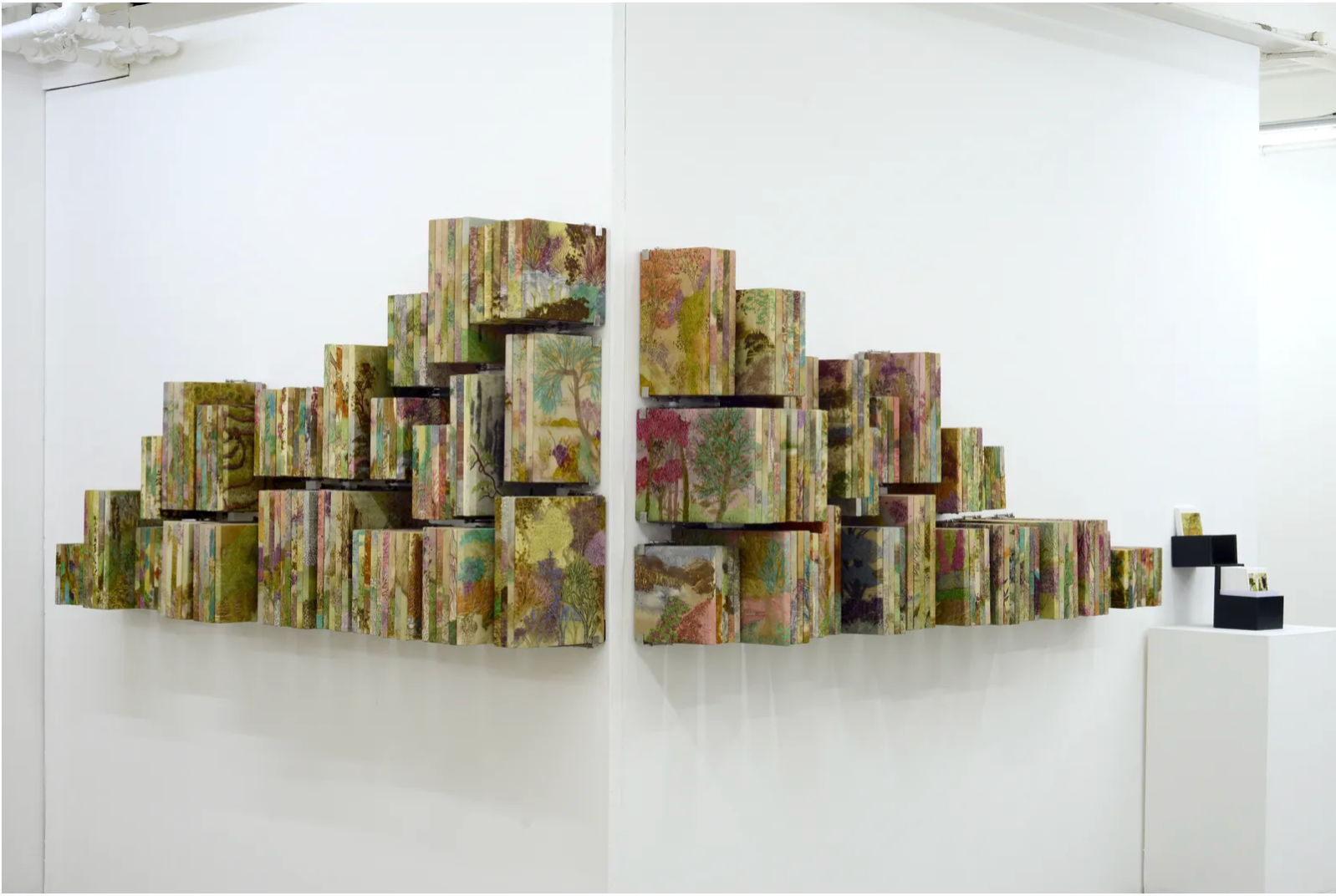
Geraldine Javier. Mt. Maculot. “All that you touch, you change. All that you change, changes you.” (Octavia E. Butler), 2025.
267 pieces of hand embroidery on eco-printed fabrics, leaves, flowers, natural dye, threads, fabrics, treated wood and 267 post cards, dimensions variable.