
Cultural identity, place and belonging are important leitmotifs in contemporary art and in everyday life. The desire to feel part of a community in the context of a nation, one’s ethnicity, and locality is intrinsic to human identity. Yet issues relating to identity, place and belonging have become increasingly politicised and problematic in the context of mobility, globalisation and heightened border security.
Reworking selected texts from my PhD dissertation, Shimmering Spaces: Art and Anglo Indians Experiences, this paper moves between academic and narrative forms of writing to discussing ideas of an entangled sense of place, culture, home and belonging across contested histories, fictive re-imaginings, and authentic lived experience. The writing shifts in location through various terrain including the Australian bush, a fictive tailor’s shop in London, and the narrator’s flat where he was born in Colaba, India. Each of these locations while tethered by the history of British colonial rule, also foregrounds the ongoing psychological impact on the colonised and coloniser including the experiences place and migration play in such complex equations.
Referencing Australia’s slow, and often inadequate attempts to reconceal its untruthful history with First Nations Australians and its ongoing often racially driven politics around immigration policies, this paper takes a personal narrative approach from the position of the author who belongs to a mixed-race community (Anglo-Indian) and is a migrant currently living on unceded Dja Dja Wurrung lands in Australia. It is the ongoing devastating experiences of colonialism, (never a thing of the past) which sits at the centre of this discourse. It highlights the physical and psychological impacts of colonialism on both the colonised and coloniser, as they reimagine a postcolonial way of living on land.
How we are represented and who has the right to determine this are not new questions. Discourse around where we belong, and with whom we may feel an allegiance, is symptomatic of the shifting and contingent spaces and places we operate out of in a more deterritorialised world, particularly in cultural and spatial terms. Writing for the 7th International Biennial of Sharjah in 2005, in his essay, Belonging and Not Belonging, sociologist Laymert Garcia dos Santos chillingly asked: “Who has the right to belong to the future of humanity, and who is condemned to disappear?”1 Twenty-one years later, we see evidence of these very questions being acted out in a world that continues to be divided by race, class, power, and culture, making Santos’ remarks feel compellingly present and relevant.
A sense of belonging is often tied to owning land, or land we believe belongs to us. Santos makes us consider the idea of belonging in a different context. He argues that the reason we desire a sense of belonging is directly tied to capitalist structures. He cites the semi-nomadic people of the Amazon, the Yanomami, and their relationship to land as distinct to Western thinking on the subject. The Yanomami believe that they belong to the land rather than the land belonging to them. And that land and territory is something ‘alive’. Because of this very clear distinction, the Yanomami cannot understand the demarcation of territory. For them, territorial demarcation does not exist. Santos cites this example as it:
clarifies the problem of belonging by contrasting the ‘primitive territorial machine’ with the ‘civilised capitalist machine’. In the former, man’s foundational relationship is with the land; in the latter, it is with abstract value. If this is true, it begs the question: how is it possible to ‘belong’, in the age of globalised capitalism, other than in a proprietary sense? Can belonging—to a country, to a people, to a nation—still make sense? Would it not be preferable to focus on not belonging.²
Correspondence (2012–2015) is the title for ‘Letters’ and ‘Asides’ that I wrote while making the photographic artworks, Bespoke and Between Dreaming and Dying. Letters were written to a character named Thyssen Krupp, who worked for a company named Thyssen Krupp and Associates – Tailors of Distinction; both are fictional. The Letter is written by the Anglo-Indian character who is the protagonist in both photographic artworks, as well as being the Anglo-Indian artist/ researcher, and the person writing this paper. In this context, the Anglo-Indian inhabits both real and fictional space. He becomes the avatar of the artist/researcher, acting out the expectations and desires of his community’s failures, hopes and anxieties, often while speaking back to the colonial gaze.
The artist/researcher is also the narrator in the ‘Asides’. The two Asides in Correspondence (2012–2015) are neither descriptive nor background to the process of making the artworks. Rather, they are a way to write about ideas during the thinking/making process. The Asides also weave in oblique references to the other artworks the artist has made over time. The narrative in the Asides while often fictional, simultaneously refers to the real space of the artist/researcher living on Dja Dja Wurrung lands and making artworks in his studio.

Rhett D’Costa, Bespoke, 2013 inkjet photographic print on 285 gsm Hahnemühle Fine Art Pearl paper, 148 x 105 cm (framed) Edition of 3. Personal collection.
CORRESPONDENCE (2012–2015)
THE LETTER TO MR. THYSSEN KRUPP
Thyssen Krupp & Associates
Tailors of Distinction
71-72 Jermyn Street, London, SW1Y 6PF
23/01/2012
Dear Mr. Krupp
I write seeking your approval regarding my attempt to dress as the quintessential English country gentlemen. Afterall it is said “Clothes make the Man.”
I could not decide on the fabric for the bespoke suit I had made in Hong Kong but I finally narrowed it down to three ubiquitous English fabrics—a plaid, hounds-tooth, and herringbone. I ended up using all three. Of course, I considered a Harris Tweed, but chose to show restraint, which is the English way – yes? A gingham shirt, matching Irish linen kerchief, Paul Smith purple brogues, a bow tie, and a red waistcoat (the red relating specifically to the ceremonial and military attire of the English nineteenth century with a nod to the red hunter’s jacket and the dandy), completed the outfit.
I wanted it to be perfect! I am sure you can sense my delight. But I must not get ahead of myself, as it is your professional validation which I await. Who other than a man of your class, distinction, and fine breeding could know better?
Please sir, I am at your mercy that you will deliver a good report. Failure is not an option.
Awaiting a reply with anticipation and humility.
Rhett D’Costa
THE FIRST ASIDE: THE ANGLO-INDIAN REFLECTING WHILE AWAITING A RESPONSE IN FRYERSTOWN, AUSTRALIA
The Englishman thinks himself too superior to write! Or perhaps Mr. Krupp did receive the letter and thinks highly of the suit? Perhaps the people at Thyssen Krupp & Associates are thinking of how to copy the suit for their own purposes. Should I continue this quest? Or is the suit a failure? Am I a failure?
Perhaps I should have used the Harris Tweed after all? But why show restraint? I am not English. Why should I care so much about their opinion anyway? Why do I need their validation?
And what to make of all the fuss by management at the Calcutta Club? Insisting on a ‘colonial’ dress code to enter their Raj-era Gentleman’s Club? Imagine in 2012 such rules persisting? The great Indian artist, M. F. Husain cannot enter because his ‘kurta’ doesn’t meet the club’s dress code. And Gopalkrishna Gandhi (Gandhi’s grandson) will not attend because he too is not ‘allowed’ to wear his kurta. Has the world gone completely mad? Everything is topsy-turvy.
They will not dare turn me away! Not in my resplendent suit. No Indian or Englishman will have that right.
THE SECOND ASIDE: AT THE SHOWROOMS OF MR. THYSSEN KRUPP & ASSOCIATES, LONDON, ENGLAND
The letter from Mr. Rhett D’Costa eventually arrives at Thyssen Krupp & Associates. On a bitter cold English day, 45 minutes from closing time, the letter is opened by Mr. Krupp’s personal assistant.
The assistant, a nondescript man with fair complexion, is granted permission to open company mail. He scans the letter hastily. It has been a long, thankless day. A little chuffed at the tone of respect in the letter, this is quickly replaced with annoyance that the request involves a response, something he will have to follow up.
The assistant knows he has been irritable lately. He thinks this justifiable given he must constantly listen to the demands of the snobbish clientele, that smug indifference of the privileged, private-school class.
With only 35 minutes before leaving his workplace, the assistant eventually looks at the photograph. He can hardly believe what he sees. The suit is absurd! It is an affront to his developed aesthetic. And the man wearing the suit even more ridiculous. He can’t feel any empathy with the request in the letter. He leans into the image looking closely with and without his glasses; perhaps the answer to such an absurd request might lie between sharpness and a blur. The person in the photograph looks smug. Yet this ‘Indian’ in the photograph, so the assistant believes, should know better. He should know his place!
The assistant sighs heavily. He is exhausted with this whole business. He can feel the tension rise in his body. If everyone just knew their place and stayed there. Literally! It would solve so many problems. He is reminded of all the Indians he encounters every day. Taking up space. Applying for his job. Speaking in odd languages. Those cooking smells that linger around the entrance to his flat. All this in his own country. He notices how they look at him. He knows they want what he has. And that they are scheming to take it. Even as they smile and offer him their food.
Everything is topsy-turvy. This whole business of immigration, globalisation and multiculturalism is too complex for him to comprehend. Yet he knows it is somehow to blame for all the problems he must contend with. He seeks simple answers to all this, like “stop the boats” which he has heard on the television used by Australian politicians. Three words, easy to understand. He nods in silent agreement each time he hears stories about refugees and hears these words.
Recently the assistant has been spending too much time daydreaming while watching the second hand move in a circulatory way around the numbers on the clock in his workplace. He takes solace in this repetitive act and the precision of its machinations. It comforts him to know that time can be compartmentalised in the roundness of the clock’s form. To think of time in another way makes him anxious. His pocket watch chimes quietly. He has fallen into the habit of running his watch 15 minutes faster than the actual time. Something to do with the day moving to slowly.
The assistant has learnt to like speed. It makes it easier to forget his present situation. The fast pace of the city provides an anonymity that he needs. He does not want time to get to know the strangers who live in his neighbourhood, who have darker skin and odd accents. It wasn’t like this. If he was aware of Milan Kundera’s mathematical equations about remembering and forgetting in the context of speed, he would agree with the writer’s hypothesis. Moving through the world quickly makes him forget. And there are things in his world he would rather forget.
It is officially closing time. His tension dissolves by relaxing his shoulders. He folds the letter and photograph. Then carefully and deliberately, tears the letter in half, and in half again until there can be no evidence of sentences and paragraphs that spelt out another person’s hopes, dreams, and aspirations.

Fragments from the torn letter to Mr. Thyssun Krupp. Rhett D’Costa, Archival photographic documentation during the writing of Correspondence (2012-2015), 2015. Personal collection.
Words lie broken. The narrative is fractured and displaced on the torn pages. Meaning still exists. But differently. Clutching fragments of photograph and letter, he stuffs them into his coat pocket, unaware that some had escaped, drifting to the workshop floor. The words, ‘fine breeding’, ‘class’, and ‘failure’ lie facing upward. These words would be swept up with the workshop debris by the cleaner, a migrant working illegally for below wage rates.
At the same instance in Fryerstown, Australia, while walking his beloved dog in the bush, the Anglo-Indian was startled by an almighty crashing sound. Even if he could magically hear the tearing of the letter in London, it would have been drowned out by the shattering of the massive eucalyptus branch now lying behind him on the bush track. Shuddering, he closes his eyes. Thoughts of weight, history, and his mortality enter his mind. It was a close call. That branch could have killed him. Unconsciously, he crouches to the ground as if gravity provided no other option. Opening his eyes, he stares at the fallen limb. He picks up a stick from a mistletoe once attached parasitically to the eucalyptus mimicking its appearance. It now lies detached from its host among the debris.
The Anglo-Indian stares at the shattered mistletoe, sensing an invisible bond between it and himself. He uses it to draw small circles in the dust repetitively. Mimicking the way his mother mixed atta with her hand when making chapatis. He found this action soothing. Recalling India, often with sentiment and nostalgia, was becoming a recurring theme recently. He remembers the sound of crows from the flat in Colaba, so different to the melodic song of magpies in Fryerstown. The Gateway of India, the heat and light. It would be misleading to suggest there existed narratives in these recollections for anyone else. Others may simply see a montage of images in and out of focus—tetrapods, the sea, interiors, images close and distant—as just that, a collection of forms and images representing nothing more than what they are. But he knew intimately that stories lived in these images. And that there were connections between the images that traced narratives, which he never really talked about. Who would he talk to about this stuff from his past anyway? Now though, these thoughts and images were becoming more important in his life.
He left India when he was six years old. His parent’s choice. He loved his home in the Australian bush. He knew India wasn’t his home anymore. He thought he had accepted this. However, there was still a strong longing in his heart which confused him. Something was left behind. Each time he returned to the flat in Bombay where he had spent the first six years of his life, he looked for traces, parts left somewhere on the door handles, on the floor, in the air. His DNA was present in the flat. He now understood Bachelard’s ideas of poetry and space. He could feel the Frenchman’s thesis in his heart.
It is impossible to imagine as the taxi pulled away from Colaba what the six-year-old was thinking. He was leaving friends, the moist heat of Bombay, and the view from the balcony flat where he sat for hours, singing about things he saw. He didn’t know Australia. Where it was or what the views would be. Would he be able to see the sea and feel a moist breeze as he could on the verandah in Colaba? As he looked out of the rear window of the taxi on the 25th day of January in 1971, that last day in India, he didn’t cry. Even though everyone else did. How could he know what emigrating meant. Or what citizenship meant? He didn’t know what ‘forever’ meant, when he asked his mother how long they were going to Australia. Time didn’t stretch that far into the future for a six-year-old to comprehend. It didn’t matter then. Theorising over a time–space nexus wasn’t an option. There was only this strange sense. Leaving India really didn’t matter that much then. It was mattering more now. Then, India was only a small space, Bombay/Colaba/303 Pushpa Bhavan. The rest of India was alien. Not a part of him. He could not formulate any questions then. He did not need any answers then either. Even now, he is unsure what the right questions were to ask. Besides, what could he do with the answers? He understands that as a migrant he may experience a gainful future but he wasn’t prepared for the profound loss leaving his place of birth would have.
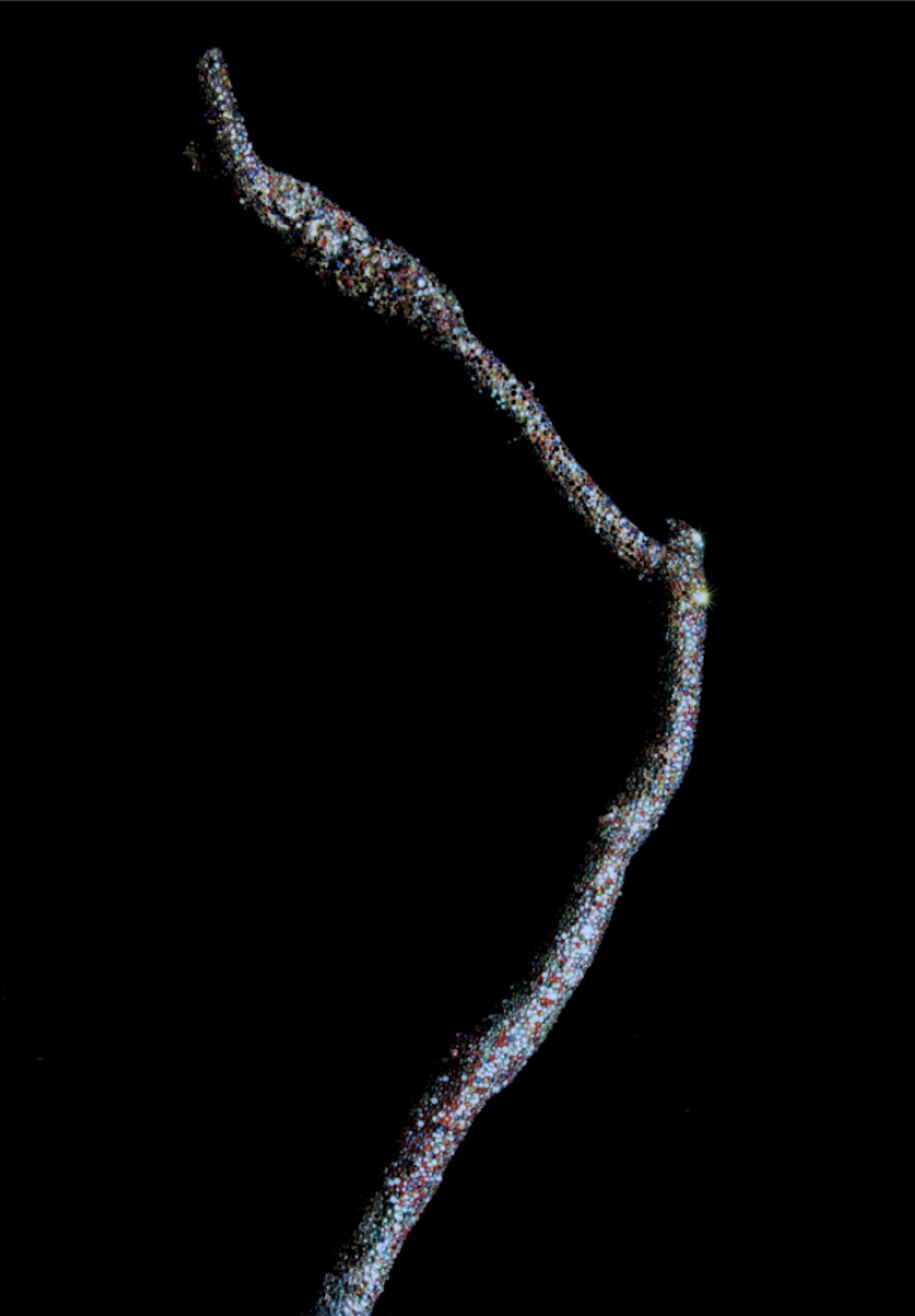
The ‘stick’ the narrator picks up in the bush would eventually become the artwork, Letting Things Be What They Are.
Rhett D’Costa, Letting Things Be What They Are, 2016. Sculpture, eucalyptus branch, mistletoe, Swarovski crystals, 90cm (H). PersonaI collection.
He sits on the dry Australian dust track. Reflecting on his history was making his body feel heavy. Simultaneously, the dry atmosphere was sucking all the moisture from his skin making him feel lightheaded. Embracing the fuzziness of remembering and forgetting, he decides to keep the stick as a memento or marker of this moment. Not knowing what else to do with it, he would take it to his studio. It could potentially become an artwork which might help him understand. He didn’t know what to do with the complexity of time, place, and space. He needed to give this equation form; a form that would help him make sense of all of this. It was form that would gradually get him closer to his own acceptance of things. It wasn’t that he only wanted the clarity of knowing where he belonged. But the assurance that comes with belonging. His Anglo-Indian community never had a place, land which they felt they belonged on. As an option, McCluskieganj³ was a failed utopia for the community.

He stands and walks slowly with his dog to the field further down the track. His white dhoti and kurta standing out starkly against his dark skin and dusty brown light. He feels liberated wearing this Indian costume. So different to the suit he had made which he knew was ill-fitting. A dhoti and kurta aren’t what he would normally wear in public. He feels he hasn’t the right to wear such a costume. But in his own solitude, the garment is loose and relaxing. It makes him feel surer of himself. It reminds him he is Indian. Migration and assimilation strategies to adjust and ‘fit into Australia culture’ seems to make being Indian harder. Dress codes were a way he thought would make him feel authentic. He was becoming aware that living in a white world was making him feel white.
He enters the field where his dogs love to run. Walking, meandering, daydreaming, and generally wasting time, seemed to take on importance these days. He liked the slowness of rural living, and the intimacy that small towns provide.
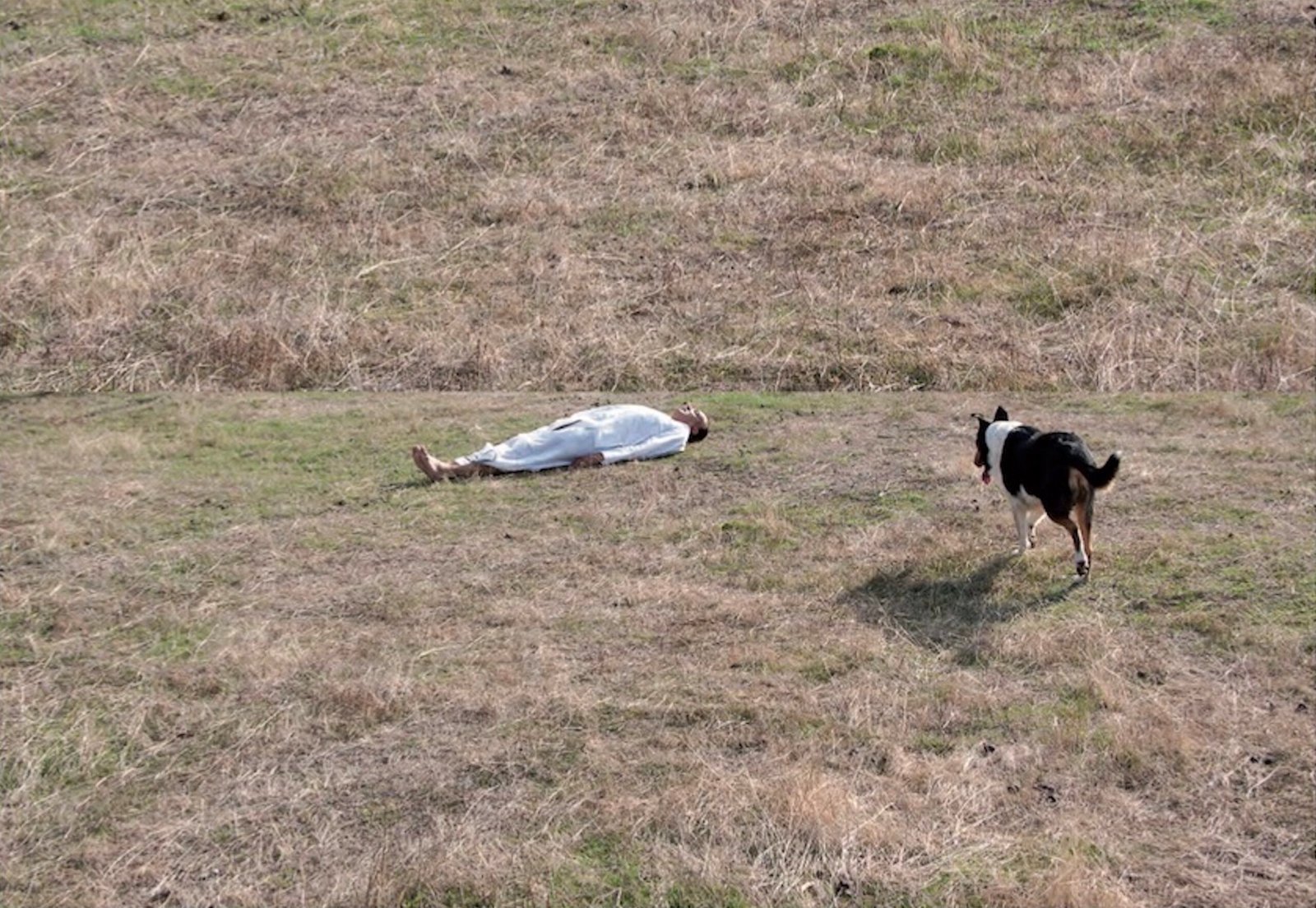
Rhett D’Costa, Between Dreaming and Dying, 2015 inkjet photographic print on 285 gsm Hahnemühle Fine Art Pearl paper, 97 x 66 cm (framed), edition of 3. Personal collection.
He lies on the bleached grass, closes his eyes and dreams about living and dying and the space between Fryerstown, Australia and Colaba, India. He feels like the character in Jeff Wall’s photograph, Citizen (1996) … asleep on the fringe of belonging and unbelonging.
He could feel the contradictory sensation of rising and falling simultaneously. Rising to the celestial stars, while sinking deep into the earth. With each breath he imagined feeling the invisible song lines pass beneath his body leading him to the Dreamtime of the First Nations peoples of this land. Deep ancestral knowledge. A sacred consciousness and connection to terra. Lying on this land in Djarra country he was able to dream of Bombay as seven islands before land reclamation. And India and Australia before colonisation.
Is this what it means to be mixed race he wondered? Not a division on racial lines. Not half souls belonging to two cultures. But rather, as another interpretation of Homi Bhabha ‘doubling’ experience, one which is expansive and inclusive, connecting rather than separating, that connects us to each other and place.
He knows he will eventually die on the rich alluvial clay soils on Djarra country. Perhaps his ashes will be scattered here. He wants this to be clear. He has his mother’s ashes which he doesn’t know what to do with. He wished he’d had this conversation with her before she died. He thought of taking them back to India to leave at her parents’ graves. Or scattering them in a memorial garden he was developing at his home. Returning ashes to land seemed right but he didn’t know which land she thought she belonged.
He was aware of just how contested this land he was lying on is. The unceded lands of the Dja Dja Wurrung. Land stolen from the Djarra people by white settler colonisers. Terra Nullius was a legal fiction, a declaration used to justify the invasion of Australia and subjugation of its people hundreds of years ago by the United Kingdom… In translation from the long-dead language Latin it means “Nobody’s Land” or “Empty Earth”. There were people in Australia when the United Kingdom came; there had been for tens of thousands of years. The declaration of Terra Nullius had the direct effect of defining the Native inhabitants as non-people.⁴
There were wars over this land. As Aboriginal activist, writer, and academic Marcia Langton points out in her catalogue essay for the exhibition, 65,000 Years: A Short History of Australian Art:
Researchers at the University of Newcastle have studied the records of massacres and found references to at least 10,000 Indigenous people killed in 416 massacres between 1788 and 1930, with more massacres recorded between 1860 and 1930 than earlier. These numbers are a minimum, as most massacres were not recorded.⁵
She adds, “as Rachel Perkins, Arrernte/Kalkadoon director of the 2022 SBS series The Australian Wars, states: ‘If there was ever a time for the Australian people to understand how their nation was born, the time is now …’ ”⁶
Yet despite the many attempts at “truth telling” of Australia’s darker histories, there remains resistance from large parts of our society—particularly from rightwing political parties who fail to accept this as necessary work that must be done, so that “Re-imagining the colonial experiences of the ancestors [can] become a pathway to remembrance and cultural continuity”⁷ not only for First Nations people, but also for settler Australians to reconcile their own generational psychological traumas resulting from colonisation. As Langton goes on to state, “Truth-telling is a form of restorative justice.”⁸ First Nation peoples continue the long, hard fight against Australian laws, successive governments, and powerful mining companies in their ongoing struggle to seek rights and control of their unceded land.
Back in London, it is past closing time at Thyssen Krupp & Associates. The assistant focusses his gaze in the mirror, straightening his worsted wool suit. He takes more care than usual, adjusting his lapel, bow tie and waistcoat. Studying his reflection carefully, he knows that the Indian in the photograph can never be who he is. His whiteness guarantees this. Knowing this assures his place in the world, somewhere higher in the order of things than the Indian. He smirks. Leaving his workplace, he decides to walk to clear his head. Walking through the city created a feeling of belonging. This was before foreigners started arriving. Now it was becoming unfamiliar and disorientating because so much was changing. To deflect such distressing thoughts, he imagines a place elsewhere. Warmer. But not foreign. A small country town in Australia perhaps? Where there are eucalyptus trees and people speak the same language and have the same skin colour. Comforting thoughts. He fantasises walking in this countryside and sleeping in a field away from the conforming structures of his present life. His imaginings longed for less complexity and expectation. He wanted to feel his body sink into firm terra. This grounding he hoped would be his salvation, clear the fog of bitterness and anger he was feeling daily. Nearing his neighbourhood, well away from his workplace, he looks forward to a nice cup of tea … at home.
In his foreword to Fanon’s Black Skin, White Masks, Appiah highlights Fanon’s exploration of the psychological damage colonialism and racism causes for colonised peoples and the coloniser.⁹ For the subjugated colonised this trauma (beside other manifestations), causes self-doubt and inferiority. While for the oppressing coloniser it destabilises their sense of humanness.
Appiah discusses how Fanon draws on his own experiences of life in the French Caribbean to examine the impact a dominant colonial culture has on the psyche of the colonised: “Black children raised within the racist cultural assumptions of the colonial system, can partially resolve the tension between contempt for blackness and their own dark skins by coming to think of themselves, in some sense, as white.”10
A sense of belonging to place is intrinsically connected to Anglo-Indian identity. ‘Home’ for Anglo-Indians has been a complex and contested site. Not helped by the fact of having an image of itself as a ‘homeless’ community within the country of their birth.
Home is not simply a physical location but a socially constructed concept. Prior to Indian Independence in 1947, the spatial politics of home for Anglo-Indians was shaped by imaginative geographies of both Europe (particularly Britain) and India. Although Anglo-Indians are born and domiciled in India, they have not, historically, and contemporaneously, been able to feel as if India is their home. Instead, and ironically, they imagined Britain as home and a British way of life, despite being largely excluded from it. As academic Alison Blunt describes, “In many ways, Anglo-Indians imagined themselves as an Imperial diaspora in British India. [However], Indian nationalism and Indianisation gave new political urgency to Anglo-Indian ideas of home and identity.”11 With the British leaving India and India reclaiming its own postcolonial vision of itself, Anglo-Indians were left to question their own sense of being and belonging. As Blunt notes, “The idea of a homeland is […] bound up with the politics of place, identity and collective memory.”12 Adding:
[…] claims to ‘natural sovereignty’ are often closely tied to claims of national sovereignty, as the idea of homeland is often mapped onto national space. Ideas of both homeland and nation exist materially and imaginatively and may relate to a place that exists in the present or as a dream, is remembered from the past, or is yet to be created.13
Referring to the German term heimat, beyond the more usual historical references used to signify racial superiority and exclusivity in Aryan sovereignty, Blunt cites academic Christopher Wickham’s writing on artistic depictions of heimat, noting how he believes that the term is no longer necessarily bound to ideas of the nation, but rather evokes longing and belonging, serving “as a point (or sets of points) of reference for individual social identity.”14 Wickham states: “for artists of the late 20th century heimat is not of the past; it has a place in the process of moving from the present to the future and is constantly under construction; there can be no question of return.”15
In Palestinian artist and art historian, Kamal Boullata’s introduction Sharing a Meaning: An Introduction, he draws on historian Frederick Bohrer’s discussion of the shared meaning of the word ‘belonging’ across English and Arabic lines. According to Boullata, Bohrer’s accounts of the English meaning of the word originally before it implied possession or ownership, had more spatial implications associated to its meaning. Belonging alluded to two things that sat in parallel or ran alongside each other in length, not necessarily in the same place, but that shared something significant wherever they were located. The Arabic meaning alludes to activity that unfolds over time.16
In conclusion, notions of belonging, of having ‘homeland’, and a place to land, is an elusive and poetic proposition that unfixes a singular location and advocates a more temporal spatiality. One which provides opportunities to reclaim terra across multiple modalities of time and space. Seen together with Wickham’s comment of home being constantly under construction, it creates a state of possibility to hope, dream and imagine. Within the ‘topsy turvy’ consequences of colonisation, migration, displacement, and globalisation, perhaps the ameliorative ‘shimmering space’ of Anglo-Indian experience can act as a model which locates the idea of ‘terra’ as simultaneously ‘on firm ground’ and ‘fractured and fragile’. Perhaps the colonised Anglo-Indian and the colonising English assistant will begin to understand the lens through which they view their futures has a shared narrative. One which posits them as post-colonial, global citizens in a historically unequal world.