
Research Note: First Walk (5 September 2020)
We followed our curiosity to the forest.
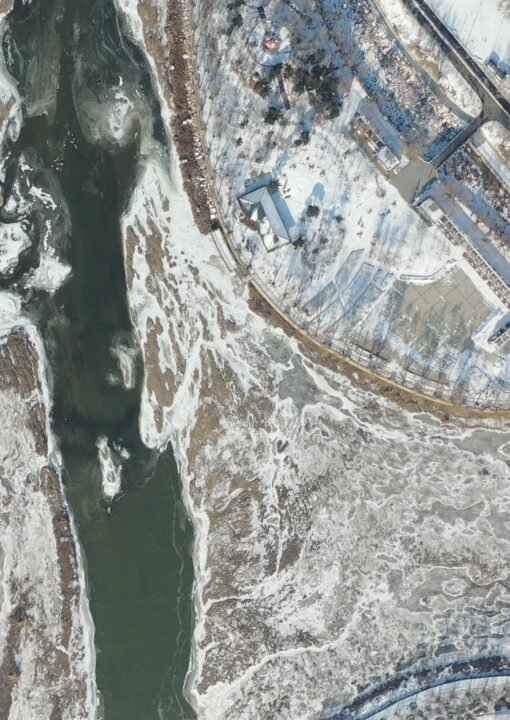
The village of Kaliurang was unusually empty that day. The two of us walked past the residential areas for an hour before taking a turn into the community forest (Hutan Rakyat). After a while, we turned right, further away from the agroforestry area where we found a recreational spot devastated by one of Mount Merapi’s many eruptions.
We went deeper and deeper into the forest. Our aim was to find the nearest water resource which we believed to be located across the hill. We could already hear the water but we could not see it. It did not bother us. We took the less-travelled footpath down the hill into a ravine. We were fascinated as we immersed ourselves into the green and shadowed depths of it. The air was crisp and cool and it smelled—green. Like a combination of fern, moss, wet ground, and foliage; we could almost taste it. The ravine was dense and lush with bamboo, kaliandra, and wild shrubs. We took a moment to take it all in: the complex freshness in the air, the sound of our steps on dried bamboo leaves, the birds, the rustling wind touching our skin.
As we climbed along the hill, the landscape changed from the narrow and cold ravine to a dense tropical montane ecosystem overgrown with various irregular, dark, and unkempt plants. There was no visible footpath and some areas were covered in cobwebs. We kept going up—heading North. What we first noticed was how messy and unusual the shape of the trees around that area was. Soon we realised the forest we were walking in was the same one that got struck with pyroclastic flow ten years ago. The trunks were burnt and the trees felled but the roots remain resilient and growing—some horizontally before going up to find more sun.
We arrived at an open field that led to a pasture. There, we found a big tree on the ground. The old white bark was like that of an elephant’s wrinkled skin. We were fascinated. To me, the dead tree reminds me of a much smaller version of Henrique Oliveira’s tree installation. I traced the surface with my hand, admiring the colour, feeling the hard flaky texture as I touched it—or rather, as it touched me. The air was clean and crisp. Around us was the sound of birds whirring and chattering, an animated natural world. I felt like I was in my element—immersed as part of it. It embraced us. We were high on tactile stimulation and experience of senses. It took us a while to get back to reality even though ironically we felt so close to the ground.
It was 15 years since I had been this close to Mount Merapi, when I had walked down the path my late father and I frequently used to take. As this dawned on me, I realised that we had gotten too close to the currently active volcano and did not know which way to go; we were lost!
[…]
The day when we, one of the artists and I, were lost in the forest, was the day we started the first walk for a series of field research conducted under two art projects: “Pollination #3: Of Hunters and Gatherers”1 and “900mdpl: Genealogy of Ghosts and How to Live with Them.”2 Framed by these as contexts, from 2020 to 2022, a series of field research was carried out at the southern slope of Mount Merapi. My research was rooted and centred around the volcano, focussing on the idea of ‘local embodied knowledge’3 and how it can be a tool to exercise environmental sustainability of the area. The research and learning process was mostly conducted orally through conversations with the elderly and gathering experiential knowledge by walking.
In Javanese, mlaku (to walk) is rooted in the word laku (translated as steps or deeds). Laku does not only mean footsteps but also a learning process to understand the meaning of things as well as the hidden meanings behind it. Laku refers to learnings gained through bodily experiences under specific circumstances, as well as those passed down orally from one generation to another in the form of local rituals, ceremonies and embodied knowledge. Laku is inclusive and contains an element of internalising values by getting involved. It requires a progressive and stimulating process to reflect and learn about the harmony between the human mind and the universe. Here, walking becomes a crucial step to take. To walk is to understand things a little better: through the touch, the sensorial experience, the pondering and the long conversations, and the findings—mythologically, philosophically, and scientifically. This learning process is similar to that of de Certeau’s idea of walking as an elementary experience to turn a place into a practiced space, a text one can read.4
That first walk when we were lost in the forest was a humbling experience. In getting lost, we extend our boundaries and venture bravely into a landscape that is foreign and new. Walter Benjamin once wrote that to be lost is to be fully present, and to be fully present is to be capable of being in uncertainty and mystery.5 The experience might not be long nor dramatic, but one might return home slightly changed after venturing into the unknown. Looking back, I remembered how I entered the forest with the blissful awe of an outsider, ignorant of the fact that the route we blindly took might be leading us astray and closer to the dangerous volcano. Our confidence gave us a false sense of security.
I am a native of the area, we did a series of conversations with the elderly prior to the walk, and we use Google maps to guide our way. We thought we knew enough to venture into the forest by ourselves. When one thinks of a new landscape as text,6 the forest just a few kilometres away from my village had apparently undergone a translation into an unknown language.7 The experience got me thinking about how distant I was to the embodied knowledge of my ancestors.
[…] I tried to remember what my late father taught me to do in such a precarious situation: first, keep your mind calm and clear and pay attention to your surroundings; second, acknowledge that you are lost and try to locate the path which you had taken. I took a deep breath and studied the landscape around me. We turned back and headed south for a while until we finally found an open pasturage.
Down there was a river, so pristine and fresh: we were finally at ease.
After our hard lesson, we started taking different ‘translators’ of the landscape to our walks: grass forager, member of the search and rescue team, agroforestry farmers, tourist hiking guide, and so on. Those who work under Mount Merapi are the native speakers of its landscape who have learnt the language early in their life and eventually become fluent in it. I imagined how to them, returning to the wilderness might feel like re-reading an old book or speaking in their mother tongue. Over time, their bodies became the unwritten archive of that site-specific knowledge. But this leaves us with the question: when knowledge is transmitted orally or through embodied experience, what is the proper academic protocol and citation process? Were stories and myths properly cited or were they considered and dismissed as backward/unmodern knowledge?
It reminded me of a particular anecdote about Bu Pujo, the rare flower picker.8 Bu Pujo was the right-hand woman of Mbah Maridjan, the late custodian of Mount Merapi. She was always there by his side whenever a ritual took place. She was the ‘mother’ who took care of climbers who were about to climb Mount Merapi. She was also the one who prepares the food and offerings for the annual procession of labuhan.9 When the labuhan is done and everyone has returned to their houses, Bu Pujo holds the crucial final task. In silence, she (and only she) will travel to the untravelled part of Mount Merapi, all the way up the slippery lava bed of Watu Kemloso, in order to find two rare flowers to be given to the Sultan of Yogyakarta as a proof that the ritual is completed. She passed away after the pyroclastic flow of the massive volcanic eruption hit her village in 2010. The eruption also took the spiritual custodian, Mbah Maridjan; it devastated 13 villages and damaged 867 hectares of forest land and killed more than 350 people. I can only wonder how she learned of the secret path to find the sacred rare flower. Did someone teach her how to read the ‘map’? Did her mother take her along the path when she was a little girl? Did she find the location where the rare flowers grew when she was grass foraging? Did she ever pass along the knowledge of how to get there before she passed away?
The annual labuhan procession is a form of offerings by the Sultanate of Yogyakarta to his spiritual allies of the mythical kingdom of Mount Merapi in the north and the queendom of Nyi Roro Kidul of the Indian Ocean in the south. Yogyakarta is surrounded by those two unpredictable and potentially dangerous forces of nature and the labuhan procession is a way to ask for protection from the geological Gods and as a form of philosophical balance between human, God, and nature.
The ritual pathways of the labuhan procession to Mount Merapi have been used since the 17th century by the Islamic Mataram Kingdom.10 Hundreds of people would gather every year to witness the labuhan ceremony and follow the lead of the late spiritual custodian of Mount Merapi and his team on the mass-walk. To walk along the ritual pathways of the labuhan ceremony is part of the laku for those who participated, whether for practical, philosophical, or spiritual reasons.
Even if Javanese mysticism has been integral to the daily life of people who live under Mount Merapi, the old debate and sentiments over the ‘modern’ science versus the ‘backward’ spirituality of Javanese ‘village mysticism’ is perpetual. Within the realm of this debate, the ‘local embodied knowledge’ is marginalised and inferior to that of science and volcanology. But historically it was not necessarily the case. Mysticism and science have actually been subtly collaborating from the beginning. When colonial scientists started to forge the volcanology in Java in early 20th Century, they took the same ritual pathways of the labuhan, accompanied by local mantri (researcher’s assistant) or kuli (porters) to do their fieldwork.11 Bobbette in his essay stated that “Colonial scientific knowledge (though the scientists themselves were not always aware of it) was enabled and shaped by the spiritual geographies that preceded their arrival to central Java.”12 It made me wonder how the scientists incorporated these embodied knowledges of the people who guided their way. Can embodied local knowledge traverse beyond the realm of a footnote into a properly credited idea to be incorporated into the main body of the paper and equally acknowledged in academic essays? But, here we ask, is it even necessary to follow the same academic protocol for a completely different knowledge system?
We were lucky enough to find our way home despite our inability to read the landscape. The experience reminded me of the local hearsay about a particular sister and brother, Lik En and Lik Es. They were the fifth- and sixth-born of an esteemed family in Kaliurang. Their parents were known for their sincere generosity. By the age of 17, Lik En lost her mind and started wandering around the village aimlessly, talking to herself. Her brother Lik Es’s mind had derailed earlier before he even turned ten years old. The family took care of Lik En whose story is lesser known to the public while her brother, though he lived in a house in the middle of a dense neighbourhood, remained undisturbed by the world that goes around him. His peculiarity left a mark on his neighbours who genuinely cared for and loved him.
In 2015, Lik Es went on a walk to forage for grass at the slope of Mt. Merapi and never returned. People believe that he went missing somewhere near Hutan Bingungan (the Forest of Confusion). For three months, the Search and Rescue (SAR) team went out to try to find him with no result. A year later, a local shaman believed that the spirit of Lik Es showed him the way and the search continued with no result. Later, people believe that he went into ‘another spatiality’.
People in the neighbourhood regularly clean the remnants of his house, and his family never sold that piece of land, all believing that one day he might find his way back home. That belief was not without a reason. The sister, Lik En, had gotten lost in the same forest of Mt. Merapi several times before. Sometimes she would walk into a forest at the slope of Mount Merapi and be found in another city around 50 km away from Kaliurang a few days later, as reported by the local SAR team. Once, she went missing for three years and then returned to Kaliurang as casually as if she had only gone for a walk for the day. Not long before her brother went missing in 2015, she had walked away and never returned since. Probably the siblings were finally able to find a way to a special place that we couldn’t apprehend, learning the language of the place that no one else can.
[…]
Hutan Bingungan or the Forest of Confusion is one of the many mythological forests located at the slope of Mount Merapi.13 Its proximity to the village made it accessible and at the same time, the myth kept it pristine and unspoiled. The forest is believed to be enchanted and cause confusion to people entering it, especially to the untrained eyes. There are anecdotes and stories about different people’s experience of getting confused due to sudden loss of sense of direction. Some say it was as if the position of the volcano was moved and the usual geological markers that we knew cannot be trusted. Grass foragers and firewood collectors would enter in groups and have their own collective systems of navigating the forest and ensuring the safety of one another. The elders in the group would guide their way based on their embodied knowledge of the forest while the younger remained vigilant and memorised the path that they took. Should anyone become confused, he just needed to turn back and locate the same path from which he emerged.
From the generation that grew up in Kaliurang in the 1920s, there is a story of another path, slightly deeper into the forest, that was once used as escape route by Javanese social bandits14 of the early 20th century to transport stolen cows from a neighbouring small town on the other side of Mount Merapi; they would butcher the cows in the forest to sell them to small businesses in Kaliurang. They would steal from colonial elites and corrupt governments as a form of socio-political protests of the lower class against repression, exploitation, and injustice of the colonial government’s agrarian tax policy. This path was later used by small traders and grass foragers post-independence but it was slowly abandoned as modern street infrastructure was built.
This time, I did not follow my curiosity by directly entering the forest (of Confusion) and instead sought answers from the elderly who had experienced entering it themselves. To my surprise, there are more people around me who had entered the forest early in their lives. My uncles and my mother were among those people. When they were young, in the 1960s, their grandmother took them there and taught them how to read the signs: how to spot a safe entrance to the forest, how many steps to take before turning to one’s right or left (never east-west because the height and density of the trees might make a person lose the sense of direction), and more importantly, how to recognise the sign of the human’s footpath to follow instead of waterways which can be easily mistaken for paths to the untrained eyes. At first, their grandmother would lead the way and take them into the forest with her guidance. Later, they learnt to recognise their way and started exploring in and around the nearest tip of the forest themselves.
This learning process is one of the Javanese embodied knowledge-transfer systems starting with niteni (to observe and sharpen one’s sensitivity to natural signs, characteristics, and repeated observation to read natural phenomena), niroake (to mimic), and nambahi (to add value and ensure timeliness and context in responding to natural events that have already been observed, understood, and controlled through the previous two steps).15 The knowledge gained from this bodily experience is dynamic and changing as the landscape changes. It exists as long as the community needs it. When people no longer walk the pathway, the footprints of the predecessors can slowly fade away, replaced by overgrown foliage as the forest regenerates. Knowledge of the pathways is no longer needed to be passed on to the next generation. Anecdotes about the forest become myth, and myth keeps the forest unknown and untouched. Today, Hutan Bingungan is one of the last verges of virgin forests at the slope of Mount Merapi amidst the massive sand mining and tourism industry in the area.
Returning to my initial question, navigating the local embodied knowledge under Western academic protocols may be like navigating Hutan Bingungan with a map: it does not share the same structure of knowledge and one might get lost inside the ‘forest of confusion’. The nature of local embodied knowledge is non-definitive and regenerative. It is not about colonising, conquering or controlling; instead, it flows alongside changes in nature. It is not about discovery or clarity but more about the ongoing learning process, a laku, an ongoing flow, a landscape continuously rewritten. The protocols of a laku and those of the more rigid academia are independent of each other. Each knowledge is valid and neither is more superior to the other.
Rather, every once in a while, they might collide and collaborate to add value to each other. Until then, it has its own right to opacity.16
Transparency no longer seems like the bottom of the mirror in which Western humanity reflected the world in its own image. There is opacity now at the bottom of the mirror, a whole alluvium deposited by populations, silt that is fertile but, in actual fact, indistinct and unexplored even today, denied or insulted more often than not, and with an insistent presence that we are incapable of not experiencing.17
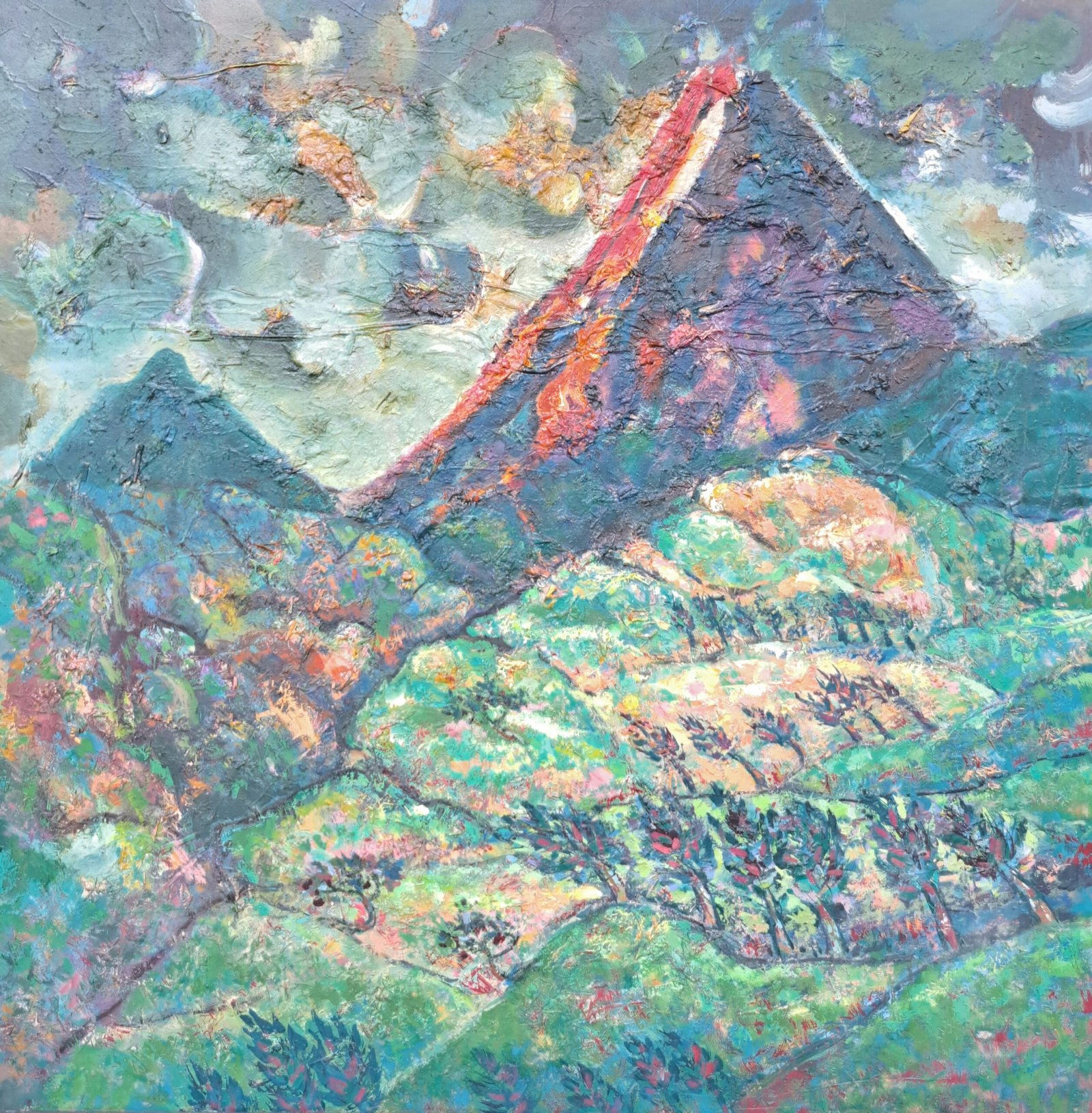
Ahmad Barokah, Merapi, 2005. Oil on canvas.